Wednesday, November 9, 2011

The Little Donkey of Divine Providence

            “Really, Father, did Don Orione say that he was the donkey of Divine Providence?” my Tagalog teacher asked me in amazement, when she read something that I had written about Don Orione for homework. I remember that she could not understand how Don Orione, who was a saint, our founder, a man of God, and a missionary, etc; had said that his vocation was to be the donkey of Divine Providence, so, I told her some stories about the Founder and explained to her very simply what it meant to him to be the donkey of Divine Providence.
            A year later, I became curious to investigate Don Orione’s statement a little more deeply, and to discover exactly what he had meant by being the donkey of Divine Providence and the implications of this in his life and ministry.

Encounter with a Strange Priest
             The Italian writer Ignazio Silone first met Don Orione when he was a child, and this encounter remained etched on his memory, for it was then that he heard the definition of the Founder’s vocation from his own mouth “to live like one of God's little donkeys.” 
             Two contrasting feelings dominated this meeting: at first Silone was rebellious and rude because he was angry that Don Orione had not gone to pick him up at the institute where he was living, but later, when he realized that the priest before him was Don Orione, his mood changed completely to one of respect, affection and friendship. He recalls:
            “I was rather taken aback by that unexpected revelation and felt thoroughly ashamed of myself. I hid the paper and blurted out some apologies for my recent impertinence and for letting him carry my baggage. He smiled, and confided that he liked to carry baggage sometimes. He went on to say something which I found enormously attractive and touching ‘about bearing burdens like a little donkey’, and then confessed: ‘My vocation in life – and now I'm letting you into a great secret! – is to learn how to live like one of God's little donkeys, a real little donkey of Divine Providence!’”

Donkeys in Place of Horses
            In several letters about the very beginning of the mission in Sáenz Peña (Chaco, Argentina), Don Orione used the expression: “if there were no horses, donkeys would take their place”, saying that he had agreed to go there, because others had refused to.
            In a letter to Abbot Caronti, then Apostolic Visitor of the Congregation, the Founder expressed his desire “to be poor and to exist for the poor” and to be “the donkeys of Providence.”These words clearly show us Don Orione’s priestly heart.
             “Fr. Sterpi will have told you that we have gone into the centre of the Chaco, at the insistence of the two Bishops and the Nunciature, for the needs of the souls there. I agreed with some reserve, and only when everyone else had refused. Even the Inspector of the Salesians told me that he had refused. I prayed a little, perhaps too little... I think the others did not agree to go because of the unbearable heat and the great poverty there; but we want to be poor and to exist for the poor. I thought that, if Your Lordship had been here, you would have given me your blessing, and I thought of all those souls and of Jesus Christ. I remembered that my mother used to tell me that if there were no horses, donkeys would take their place. Well, we are the donkeys of Providence, or at least that is our desire.
            If I knew that I would be staying over here I would ask you of I could go into the Chaco to die there, there to spend my entire self and to live as a true missionary (...)
            Here, the Chaco is considered worse than Patagonia. There is so much to be done and so much to be suffered; it involves a total sacrifice of oneself for the Lord, for souls and for Holy Church (...)
           And now I will end. Please excuse my long-windedness, My Lord, but permit me to beg you to leave me here as long as you can. Then, if God should inspire you to leave me here forever, if that would be for my own good as well as that of the Little Work, please just leave me here permanently, or imprison me and cast me  wherever you think best in the Lord. I will always be most happy in the Lord.
            I have one wish, and that is to love the Lord and to love Holy Church, souls, the poor, the poor children, the forsaken, the humble classes, the workers, the communists. I would like to die for these people. They are my brothers and sisters. I would like to be forgotten by everyone, to live and die forgotten by everyone, beneath the feet of everyone, just loving Jesus, the Holy Church and everyone, lost in the Lord. I am so unworthy, so sinful. I have been so wicked towards the Lord and Our Lady, not appreciating the gifts of the Lord.” (Buenos Aires, 17th March 1937)

Jesus Preferred Donkeys
            In another letter about Sáenz Peña, he pursued the same idea, but with the additional point that Jesus had a preference for donkeys, because he chose to enter Jerusalem riding one.
            For Don Orione, his and his sons’ happiness is to be “the donkeys of Jesus, the Pope, bishops and souls!”
            “It is very hot in Chaco and nobody wanted to go there, so in the absence of horses, donkeys can trot! Oh, yes! Our desire is to be the little donkeys of Divine Providence.
            Jesus preferred donkeys, didn’t he? – After all, he rode into Jerusalem on a donkey, didn’t he? Yes, yes, how blessed we will be if we can be the donkeys of Jesus, the Pope, bishops and souls! Pray, do please pray, Countess, that we may  always remain poor, small, humble, like donkeys, and heart and soul for Jesus and Holy Church; small and humble at the feet of Mother Church. And now I'll end. If it pleases God, I will return in July. Then, if they let me come back, I will gladly do so to lose myself in Jesus and souls in South America”. (Letter to Contess Dolores Cobo de Marchi di Cellere. Rio de Janeiro, 10th April 1937). 


             His idea is rooted in the biblical tradition of the meek and humble Messiah, who enters Jerusalem riding on a donkey, a mere pack animal. “This was to fulfill what was spoken by the prophet: say to the daughter of Zion: Look, your king is approaching, humble and riding on a donkey and on a colt, the foal of a beast of burden.” (Matthew 21: 4-5).

Something about His Sense of Humour
            Don Orione would also laugh and joke at his own expense, comparing himself to a donkey.
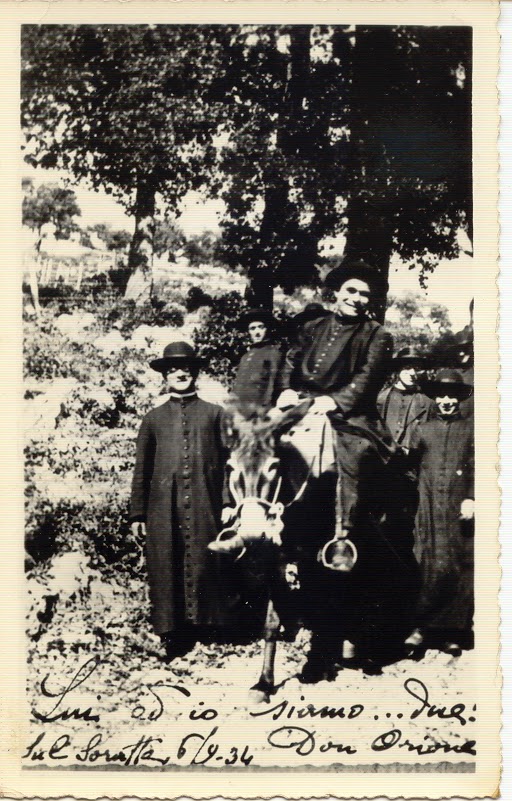
            On a photo of him mounted on a donkey, taken when he was on the way down from Monte Soratte after visiting his hermits, we can see these words….“The donkey and me...two of a kind!”  (Lui ed io siamo… due!”  in Italian) in his own handwriting at the bottom.

In Conclusion
           Being a “donkey of the Divine Providence” was not a mere figure of speech for Don Orione, it was the deep conviction by which he lived. The Founder’s desire was to be small, humble and poor for the poor, because this was the desire of Jesus.
            He also wanted this for his sons, who should also be little donkeys of Providence, signifying poor, small and humble, as he himself was. As Don Orione saw it, we may not be the best, but we have to go and be where “the best ones” do not want to be; we have “to be poor and to exist for the poor.” Don Orione believed this to be our place.
            Nor should this make us resentful or conceited, but it should help us to be humbler and to discover, or rather rediscover, that we were born for the poor, for those who nobody else wants to care for or to look after; we have to go to the very poorest among the poorest, exactly as Don Orione desired.

Fr. Facundo Mela fdp

Cf. The Bridge (Autumn 2011), 8-10.

Saturday, November 5, 2011

Don Orione’s Sunday Activities: “Everybody was waiting for me”

After three month on Brazil, St. Luigi Orione wrote to one seminarian, Domenico Sparpaglione, encouraging him to study, to pray and to become a saint priest. But Don Orione also shared with Domenico his experiences in Brazil, showing us his priestly heart.


Mar de Espanha, 17th October 1921
  
My dear Sparpaglione,

... I have been preaching in Portuguese since 8th September.  Yesterday being Sunday I preached several times.  I said two Masses, one here and the other sixteen kilometres away, where I arrived at twelve-thirty in a village where there is no priest.


The one who was the Parish Priest, now quite old, went to Rio for treatment and will not be coming back.


Everybody was waiting for me and, when they saw me arrive, they started to wave their handkerchiefs for joy. They had been waiting there all morning, poor people! And their church is so bleak and I wanted to weep, and at the altar I vowed once more to the Lord to be a good priest, seeing the total faith of that abandoned people.


The church was "cheia" (full), and they sang, and at those hymns I wept with love for God and souls, and with sorrow to see the people without a priest to baptise their children, to comfort their sick, to bless the graves of their departed!  I read the Gospel, I baptised, I read the banns of marriage, I received their children and attended their sick!  They asked me if they could have Masses even if only for Saints' Days and for the Dead!  I hope that either I or another of us can go.


Here we have six or eight horses, and we go by horse.  Our horses, like the cattle here, do not have a stable or a shed, they are out on the pasture day and night, and graze on the land of our "sciaccra" (little farm) which are vast.


(...) I was at Sao Paulo and the Archbishop asked me to look after the Italian immigrants at Braz, a district of the city completely made up of Italians. The Italians of Sao Paulo must be at least two hundred thousand; it is the largest settlement that Italy has outside of our Homeland. At Braz the Italians are born and die without the comforts of our Faith. I hope that Divine Providence will help us; I accepted it; I could not, must not, say no.  (...) 


My dear sons, here our harvest of golden corn gets greater and greater, and the field of work, the field of charity, of souls, gets wider, but the hands are few! Hurry up and get ready, hurry up and develop, hurry up and come. I need new reinforcements in addition to the four already requested from Fr. Sterpi: I need at least two other good priests for Sao Paulo and two other good and true seminarians.  I pray that Our Lady will send me them, but that they will be good and full of piety, work and sacrifice!


I bless you all with the love of a father in Jesus Christ and, in His Heart, I embrace you spiritually, and I place all of you in the hands of Our Most Blessed Lady.

Fr. Orione of Divine Providence.


Thursday, November 3, 2011

"I have a special place for you: Payatas."


Last 5th October, the Sons of Divine Providence celebrated the 20th anniversary of the arrival of the first missionaries to the Philippines. This celebration can only be understood looking at the history.

The Meeting with Cardinal Sin
In February 1991, Fr. Giuseppe Masiero, Fr. Angelo Mugnai and Fr. Oreste Ferrari met with Cardinal Jaime Sin, archbishop of Manila, who knowing that they wanted to work on a depressed area, said, "Would you like to work with the poor? I have a special place for you: Payatas." Then they visited the area which was a just place for the Congregation. After accepting it, they met some priests who worked in Payatas and began the necessary preparations for this the new mission.


The dream begins to come true
On 5th October 5, 1991, the first Don Orione religious came to the Philippines: Fr. Luigi Piccoli, Fr. Oreste Ferrari and two lay people, together with Fr Angelo Mugnai. This was the beginning a new chapter missionary of the Congregation. Their challenges were to learn Tagalog, to know the Filipino culture and to organize the pastoral work. Meanwhile, the community lived in Fillinvest, a neighboring district, because there was no the parish house.
On 12th January 1992, Cardinal Sin created a new parish, "Mother of Divine Providence", appointing Fr. Luigi Piccoli as the first parish priest. 


The Mission Grows and Strengthens
After starting the pastoral activity, on 12th July 1992, the community moved to Payatas and in that November, the first charitable activities began: a daycare center for children in Sagrada Familia chapel.


The following years will be years of growth and strengthening, where new missionaries arrived and the pastoral and charity activities multiplied: the orphanage in Payatas, the first Filipino aspirants, the feeding program, the savings program, the Cottolengo Filipino, the Montalban community, the novitiate, the educational programs, the free clinics, the arrival of the little missionary sisters of charity, the creation of PAOFI, the first Filipino priest’s ordination and recently the third community in Lucena.


The Future
This celebration is also an ending as well as starting point. An ending point because we can see the fruits of twenty years of pastoral and charity work. A presence that is growing and has already a Filipino face and heart. A starting point also because it invites us continue offering the Don Orione charism to the Filipino people.
     

       Divine Providence on his loving plan has given to the Sons of Divine Providence the possibility of making true Don Orione’s dream, so pasalamatan natin ang Diyos sa Kanyang mga biyaya at mga pagpapala! (Let us thank God for the graces and his blessing!).

Wednesday, November 2, 2011

Courage, Brothers: Forward with Christ!


The day will come when the nations, gathered around Christ will feel themselves to be sisters!  From Pentecost onwards the divided nations tend towards unity, and will join one another; but in Jesus Christ, Our Lord and our God. 

FORWARD WITH CHRIST! Who is there who does not see the ground being prepared for the greatest triumph of Christ, in the spiritual unification of the whole world under the Cross?

This time could not be achieved in a day, but had to be the work of centuries, had to be the perennial way of the Church which shines and lives with the life of its Christ, until the whole universe is one single fold under the guidance of one single shepherd.

FORWARD WITH CHRIST! There will be then one word, one thought, one throb of all the centuries: Jesus Christ!

There will be one Faith, one baptism, one Shepherd: Christ in His Vicar, the Pope!

The work of Christ, the work for which He was born, lived and died: the work that He did and expressed by example, words and miracles, by the sacraments, by the Church and by the divine and everlasting sacrifice of Himself, is this: that the human race, separated from God and divided in itself, should be re-united with God and with itself, in the Holy Church of Jesus Christ and God.

FORWARD WITH CHRIST! He redeemed us in sorrow, and advances to lead back human kind in sorrow to its original unity. And the life of the Church, while ordered to a great unification, is the continuation of the life of Calvary, and reflects in its very self Jesus Crucified, His sorrow and His sacrifice.

FORWARD WITH CHRIST! Today, He Himself has taken in hand its cause and that of the people. It is He who fights for His Church, doing justice to all who grieve it; to all who today or yesterday could have, or should have come to the defense of that sweet Christ on earth, and did not do so. It is He who fights now, but, because Christ is the Lamb of God, He will conquer in mercy!

So, have courage my brothers!
Rejoice, and lift up your hearts even higher, crying: Sursum Corda!
Exult in the radiant dawn of God: Heaven is opening: Magister Adest!
Look at Him: it is He, Christ who is coming!


Instaurare omnia in Christo!


18th  January, 1905.


Feast of the Chair of St. Peter, Apostle, in Rome.


My most venerable Father in Our Lord Jesus Christ Crucified (Mgr. Band )


For more than ten years, that is right from its beginnings, the humble Congregation the ‘Work of Divine Providence’ which the goodness of God caused to be born at your feet and in this city of San Marziano, took, we believe through the provision of the Lord, as its motto and programme the ‘Instaurare omnia in Christo’ of the Apostle (Eph. ch. I, v.10).


This motto has become our stamp, and is printed at the head of our documents and written most brightly in purple letters on the flags and on the white banners which adorn and flutter above the houses of Divine Providence on great feast days.


The ‘Instaurare omnia in Christo’ placed at the foundation, I would say, of the Rule which your most Reverend Excellency was kind enough to approve, is, by the grace of God, in the hearts of the many Sons of Divine Providence: it is repeated every day, in this and in other houses of the Work, by members of the Congregation, by the young students in our Institutes of Christian Education and in the Agricultural Training Schools, before and after work, as well as in the pious exercises themselves. So, the ‘Instaurare omnia in Christo’ was always almost an invocation, the idea that combines the whole mission of the Work and its sacrifices; the pass-word, the light that vivifies, lifts up and marks the whole purpose of our living and working in common, and the sigh  of our life and of our death;  it is especially intended as a vow addressed to God, an aspiration, a prayer, a fervent desire that the whole man, as well as all humanity, should be renewed in Jesus Our Lord.


The day on which I was permitted to profess the holy, religious vows at the venerable hands of Your Excellency (April, 1903), I begged You, my dearest Father in the Lord, to make this ‘Instaurare omnia in Christo’ more effective and meritorious for us and for souls, by granting an indulgence to this saying of St. Paul which had become ours, as an aspiration, already written by the Apostle, under the inspiration of the Holy Spirit. And Your Excellency then appeared to be very well disposed to it; but I had to leave almost immediately, and nothing more was done about it.


Excellency, kneeling at Your feet, allow me in my own name and in the name of all my brothers in religion, in the name of our young people and in that of so many friends and benefactors of the Work, to humbly repeat the ancient prayer. Immediately and warmly I beseech you, for love of Our Lord Jesus Christ Crucified and for our most merciful Mother, Our Blessed Lady, from all the spiritual treasures at your disposal, to deign to enrich the words of the Apostle Paul ‘Instaurare omnia in Christo’. Whether they are pronounced by one person or several people as one phrase, or whether pronounced separately and by many individuals, as is the custom in the houses of the Congregation where ‘Instaurare omnia’ is said, with the reply ‘In Christo!’. These words are like an aspiration and a wish of our souls that Christ should be resurrected in all hearts, and should renew the whole man and all men in Himself.


I thank you, my most venerable Father, for this act of paternal affection towards the Work of Divine Providence, and for the remarkable comfort it will bring to our friends and benefactors, and to many pious souls of the diocese, and not just this diocese!


Rather, I should say, my good Father, that the inspired expression of the Apostle, by becoming an aspiration of Faith and religious hope, rich in spiritual treasures - while displaying the greatest need of the world - , I am confident it will become an echo in the hearts of the sons to the desires of the Holy Father, Pius X, and will unite them more to Him, which is exactly in the intentions of our Congregation.


Instaurare omnia in Christo! will express our whole Faith, hope and love: it will be the good-will greeting of the dawn of God over us, the dawn of better days in which Christ lives, reigns and triumphs in all and through all!


           In filial reverence and affection in Jesus Christ, I kiss Your Sacred Ring.

Tuesday, November 1, 2011

Divine Providence Explains Everything


Divine Providence seems hidden from man, because sees it but very often does not like it, he touches it but very often does not believe it; it clothes him better than the lilies of the field and already feeds him, yet he thinks he is naked and hungry. It governs the world with harmonious and eternal laws; it hides and is not seen by those who lack Faith, even though they may be materially rich, or have great minds and much culture. Yet, those who are powerful, rich and truly wise on earth are the ones who love God, believe in God and hope in God, and in the works of His hands they see Him, touch Him and hear Him, even in the things he says: be calm, I am with you: Nolite timere, ego sum! (Do not be afraid, It is I!)- These live in Providence, and die in Providence. They are simple people, and their lives are considered by the world to be folly, but they are the wise ones of the Lord! 

           For God’s ways it is not necessary to know a lot, but to know Jesus Christ Crucified, to love Him in souls and in His Church which at this time stands on Pius, and to serve Him with great humility and great eyes of Faith in Divine Providence. Do you want to see things that you do not see? Believe blindly in whatever our Mother the Catholic Church proposes. The more you believe her and really have Faith, the more you will rise above men and will see things differently, and feel within you the joy of the children of God, because the light of Divine Providence is truth and love and joy, and will be in you and over you.

Divine Providence explains everything; it is the finger of God in the universe and the balm of life. O Divine Providence! O Providence Divine! I love You, I adore You, and I lose myself infinitely in You!

Divine Providence, Inspirer of Charity

O Divine Providence, O Divine Providence!  Nothing is more loveable nor adorable than you, who like a mother feeds the birds of the air and the flowers of the fields: the rich and the poor! You open the way to God and fulfil God’s great plans in the world!

All our trust is in you, O holy Providence of the Lord, because you love us much more than we love ourselves! No, with divine help, I no longer wish to investigate you; No, I no longer want to tie your hands; No, I no longer want to cripple you; I only want to abandon myself completely into your arms, calm and peaceful. Make me take you as you are, with the simplicity of a child, with that generous Faith that sees no limits! ‘Faith, Faith like that...’ like that of Blessed Cottolengo who found light everywhere, and saw God in all and for all! 

Divine Providence! Divine Providence!  Give me, your poor servant and cobbler, and those souls who pray and work silently, sacrificing their lives among the poor, and give to our dear benefactors that largeness of heart and of charity, that does not measure good by the metre, nor by human calculation: that charity which is sweet and gentle, which does everything for everyone: which places its happiness in doing every good to others in silence: that charity which builds up and unites in Jesus Christ, with simplicity and candour.

O Holy Divine Providence! The inspirer and mother of that charity which is the motto of Christ and of His disciples: animate, comfort and fully reward in Heaven and on earth those who, in the name of God, act as father, mother, brother or sister to the unhappy ones. 

Our weakness does not dismay us: we look on it as a trophy of the goodness and glory of Jesus Christ. Nothing is dearer to the Lord than trust in Him! And we would like to have such great Faith, courage and confidence, as great as that of the Heart of Jesus which is its foundation. 

The Little Cottolengo stands in the Lord, in Faith; it lives in the Lord, from Divine Providence and from your generosity; it is governed in the Lord, that is to say, with the charity of Christ: everything and only through love, up to the offering of our life, with divine help.

And no employees! No bureaucratic formula which often cause worry, even if they do not make the good humiliating: nothing which resembles administration: none of that.

Everything depends on Divine Providence: it is Divine Providence that does everything, and the charity of merciful hearts, shown by their desire to do good, just as the Gospel teaches, to those most in need.

Perhaps you think we have funds and private incomes. No, my friends, we have less than nothing of the kind. The Little Cottolengo has no private incomes, and will never have incomes of any kind: it goes on, day by day: ‘panem nostrum quotidianum’ [our daily bread]. 

That God who is the great Father of all, who thinks of the birds of the air, and clothes the lilies of the field, sends our daily bread from His bounteous hands, that is to say, whatever is needed day by day. 

Our bank is Divine Providence, and our bag is in your pockets and in your kind hearts. 

The Little Cottolengo is built on Faith and lives on the fruits of inextinguishable charity. In the Little Cottolengo we live happily: we pray, we work, to the best of our ability: we love God, we love each other and we serve the poor. We see and serve Christ in holy joy, in the abandoned ones. Who could be happier than us? 
And our dear, poor people live in contentment: they are not guests, not inmates, but are the masters, and it is we who are their servants; and that is how we serve the Lord!  How lovely life is at the Little Cottolengo! It is a symphony of prayer for benefactors, of work, of joy, of singing and of charity.